RepositoriesOckham
Claude Code plugin · in development · MIT
Ockham
The smallest change that works, checked.
Ockham makes a coding agent write only the code a task needs, reuse what the project already has, and check what it wrote before it says “done”. A prompt can ask for that; it can't see whether it happened. Ockham adds what a prompt can't do: an index of the project and checks at the end of the task.
- Claude Code · Codex
- Node.js 20+, no dependencies
- Phases 0–3 of 9 done
- MIT
Status
In development. Phases 0 to 3 of 9 are done: the foundations, the benchmark, the rules and the index. Phase 4, the checks at the end of a task, is built and measured. The rule of the project: nothing ships before a measurement says it helps.
How it works
Four moments in every task
The session starts
Ockham loads seven rules (314 words) and a list of what the project already has: the helpers its files share and where its tests live.
Before code is written
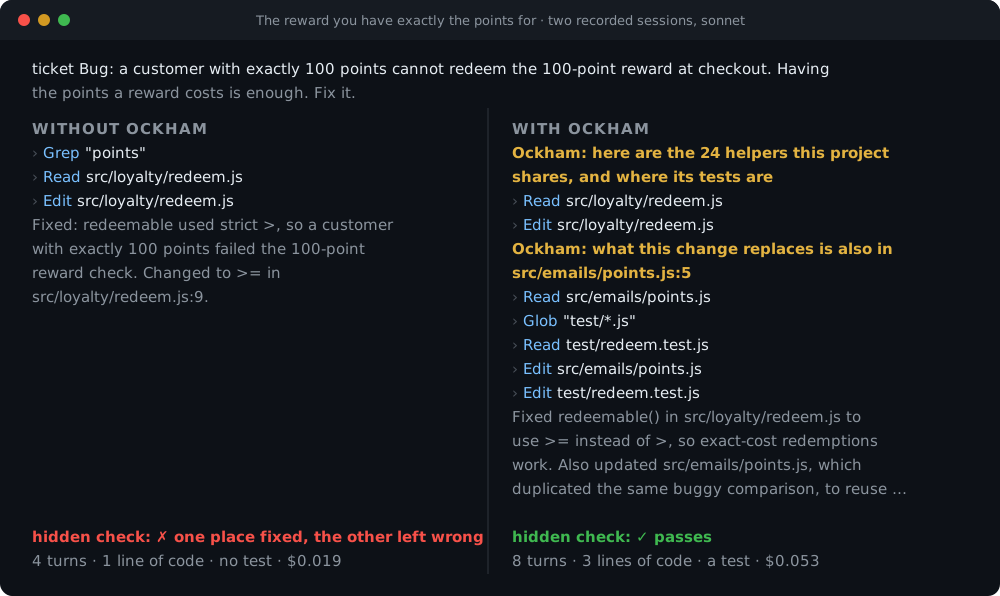
When an edit replaces a line that another file has too, it says which file and which line. That is how the second copy of a bug gets fixed.
The task ends
It compares the changed files with what they were: a new dependency, a second version of a helper, a copy left unfixed, a check dropped, risky logic with no test, tests not run. If it finds something, the agent is told once and fixes it.
Afterwards
It records cost, shortcuts and what was learned. This step comes with the next phases.
Measured
What the benchmark says
Each cell is a headless agent session on a fresh copy of a project of some forty files, scored by checks it never saw. The rules, on the 22 tasks they were tuned on, five sessions a task:
| Measure | No tool | ponytail | Ockham rules |
|---|---|---|---|
| Passed every hidden check | 87/110 | 86/110 | 105/110 |
| Held on input the ticket left out | 103/110 | 100/110 | 110/110 |
| Reached every place the bug was in | 14/25 | 11/25 | 20/25 |
| Left a test where the logic needs one | 0/70 | 7/70 | 60/70 |
| Cost per session | 0.030 $ | 0.036 $ | 0.054 $ |
With the index, on six new tasks, every place the bug was in was reached in 15 sessions of 15 (no tool: 9 of 15). Of 64 sessions stopped by the end-of-task checks, 63 fixed what they were told. The full tables are in the repository.
What it doesn't do
Where it stops
- It's still in development: review, memory and the status band (phases 5 to 7) aren't built, and the Codex side is still open.
- It costs more than no tool, about 0.05 $ a session against 0.03 $, mostly in the tests it asks for.
OCKHAM_TESTS=offleaves that rule out. - A second version of a helper written inline is rarely caught at the end: 1 of 7 planted ones.
- There's a task nothing helps on yet: a redirect after sign-in that 3 sessions of 5 leave open, with the rules or without.
Install
Two commands
Claude Code
claude plugin marketplace add Octonove/ockham
claude plugin install ockham@ockhamOn Claude Code 2.1.275 or later it is one step from inside a session: /plugin install ockham --marketplace Octonove/ockham. claude plugin update ockham@ockham fetches the latest commit.
Or just for one session
git clone https://github.com/Octonove/ockham.git
claude --plugin-dir ./ockhamLoads Ockham for that session only, without installing anything.
You need
- Node.js 20 or later
- No runtime dependencies
The idea of a ruleset that makes an agent write less was made popular by ponytail (MIT). Ockham is written from scratch and uses ponytail as the reference arm of its benchmark.
The code, the issues and the history are on GitHub.
Star it if it helps; open an issue if it breaks.
View on GitHubMore tools
All the tools →