RepositoriesAgent Dispatch
Agent skill · MIT
Agent Dispatch
The model is picked by the type of task, never by the importance of the project.
Unless something sets a model, Claude Code runs every subagent on the model you chose for the session, so the agents translating a strings file cost the same per token as the one designing the architecture. This skill makes the split explicit before anything launches, and reports what was spent after.
- Claude Code · Cursor · Codex · Gemini CLI
- One SKILL.md
- English and Spanish
- MIT
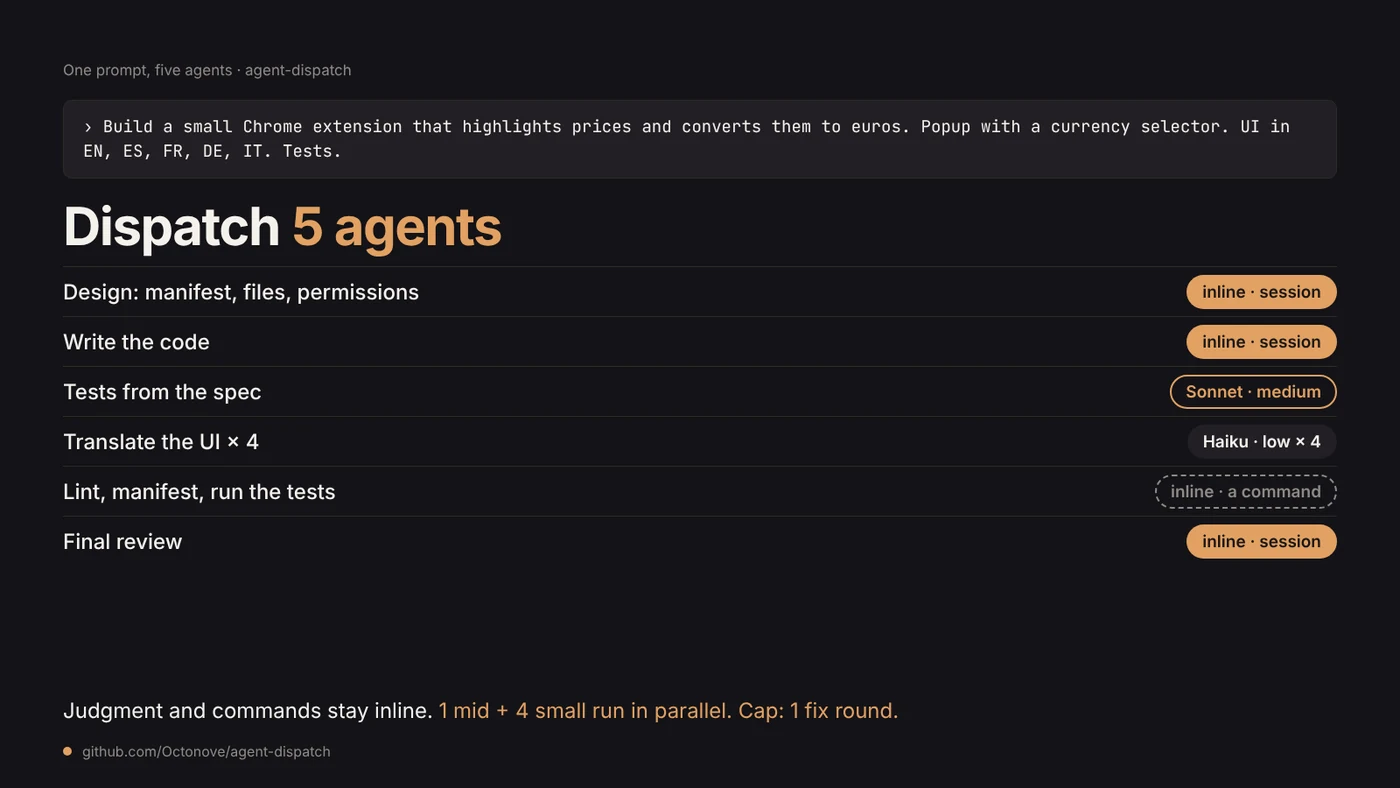
Dispatch: 5 agents · 1 mid (tests) · 4 small (translations) · inline: design, code, lint + tests, final review · cap: 1 fix roundThe rule
One table
| Type of task | Examples | Model · effort |
|---|---|---|
| Mechanical | Translations of fixed strings, listing, counting, extracting fields, cutting a long log down to its errors | Small (e.g. Haiku) · low |
| Bounded analysis | Summarising a module, mapping dependencies, tests from a clear spec, one mechanical change across many files | Mid (e.g. Sonnet) · medium |
| Judgment | Architecture, the code that decides how something works, choosing between options, the final review | The session's model |
Guardrails
What it tells the agent to keep
Delegate at all?
The default is no, and the count starts at zero. Checking what a command can check is never a reason for a subagent.
The reviewer never gets cheaper
Judgment stays on the session's model, and so does the final review.
One retry, a tier up
A small or mid agent that fails gets its one retry on the next tier, never again on the same model.
Self-contained briefs
Every subagent gets the goal, the minimum context, what it must not touch, the output format and when it's done. It never sees your conversation.
Every loop declares its cap
The success condition and the maximum number of rounds, before it starts.
Declare, then measure
A dispatch line before launching and the spend your tool reports after. No invented savings.
Install
One file
Claude Code, as a personal skill
mkdir -p ~/.claude/skills/agent-dispatch
curl -fsSL https://raw.githubusercontent.com/Octonove/agent-dispatch/main/SKILL.md \
-o ~/.claude/skills/agent-dispatch/SKILL.mdOr as a plugin
/plugin marketplace add Octonove/agent-dispatch
/plugin install agent-dispatch@agent-dispatchIn Spanish: es/SKILL.md, or the agent-dispatch-es plugin. Cursor, Codex, Gemini CLI and other clients: see the README.
You need
- Claude Code, Cursor or any client that reads Agent Skills
What it doesn't do
Where it stops
- It doesn't give you a savings number. It can't measure what your tool doesn't report, and it won't invent one.
- Judgment never gets cheaper. If you want everything on the smallest model, this isn't the skill for you.
- The install paths for Cursor and other clients come from each vendor's documentation and are untested.
It is also section 1G of The Orchestrator, the Invokard card that routes every request: if you use that card, the dispatch is already inside it.
The code, the issues and the history are on GitHub.
Star it if it helps; open an issue if it breaks.
View on GitHubMore tools
All the tools →